


Most career advice is written for people who leave.
Take the better offer.
Get the bigger title.
If they won’t promote you, promote yourself somewhere else.
Leaving is active. It photographs well. You get to announce a new chapter and thank everyone who was part of your incredible journey.
Nobody opens up LinkedIN and posts:
Most career advice is written for people who leave.
Take the better offer.
Get the bigger title.
If they won’t promote you, promote yourself somewhere else.
Leaving is active. It photographs well. You get to announce a new chapter and thank everyone who was part of your incredible journey.
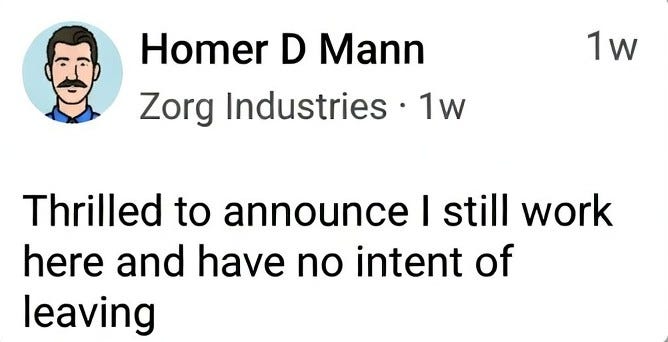
Nobody opens up LinkedIN and posts:
‘Thrilled to announce I still work here and have no intent of leaving.’
But staying can be a strategy too.
My friend Franklin has spent 35 years at the same television network. Not a sleepy television network, either. A famously chaotic one in an industry that has spent the last three decades being set on fire by technology.
He didn’t survive by hiding under his desk.
He became useful in ways that compound.
First, no task was beneath him. If something needed to get done, he would help get it done.
That doesn’t mean doing everybody else’s job.
There’s a difference between being willing to carry the bag and becoming the company mule. If you constantly rescue people, eventually they stop learning how to swim.
The skill is knowing when your involvement saves the outcome and when it merely saves someone from responsibility.
Franklin also accumulated something companies claim to value right before they lay off everyone who has it:
Institutional knowledge.
Institutional knowledge isn’t remembering where the old files are stored.
It’s knowing how decisions actually get made.
The org chart tells you who is in charge.
Institutional knowledge tells you who needs to agree, who only needs to feel consulted and which objection means no even when the person saying it uses the word “maybe.”
It also tells you people’s tendencies. Being able to (correctly) predict how people will react to a certain thing is invaluable in life and in business.
That knowledge makes you particularly valuable when a new boss arrives.
The new boss has authority.
You have the map.
Used badly, that becomes corporate politics: hoarding information, protecting territory and watching somebody step on the land mine because they didn’t ask your permission.
Used well, it becomes judgment.
You can tell someone which battles matter, which battles are winnable and which battles will leave them bleeding on a hill nobody remembers asking them to take.
Thirty-five years also puts a lot of chips in the bank.
Make a mistake after six months and people wonder if hiring you was the mistake.
Make one after 25 years of being dependable and it’s Tuesday.
Of course, staying isn’t automatically noble.
You can remain somewhere because you’re growing, accumulating trust and becoming more valuable.
You can also remain because updating LinkedIn sounds exhausting.
Leaving isn’t automatically brave, either. Sometimes it’s just restarting before anyone notices you never learned the last place.
The better question is not:
Should I stay or should I go?
It’s:
What is compounding?
If the answer is your judgment, relationships, knowledge and influence, staying may be producing something another salary bump can’t replace.
If only your years of service are increasing, you may just be getting older in the same chair.
Some people build careers by repeatedly opening new doors.
People like me.
Franklin built his by learning everything about the room he was already in.
Neither choice is automatically right.
But don’t confuse movement with progress.
Sometimes the longest way forward is staying exactly where you are.
But staying can be a strategy too.
My friend Franklin has spent 35 years at the same television network. Not a sleepy television network, either. A famously chaotic one in an industry that has spent the last three decades being set on fire by technology.
He didn’t survive by hiding under his desk.
He became useful in ways that compound.
First, no task was beneath him. If something needed to get done, he would help get it done.
That doesn’t mean doing everybody else’s job.
There’s a difference between being willing to carry the bag and becoming the company mule. If you constantly rescue people, eventually they stop learning how to swim.
The skill is knowing when your involvement saves the outcome and when it merely saves someone from responsibility.
Franklin also accumulated something companies claim to value right before they lay off everyone who has it:
Institutional knowledge.
Institutional knowledge isn’t remembering where the old files are stored.
It’s knowing how decisions actually get made.
The org chart tells you who is in charge.
Institutional knowledge tells you who needs to agree, who only needs to feel consulted and which objection means no even when the person saying it uses the word “maybe.”
It also tells you people’s tendencies. Being able to (correctly) predict how people will react to a certain thing is invaluable in life and in business.
That knowledge makes you particularly valuable when a new boss arrives.
The new boss has authority.
You have the map.
Used badly, that becomes corporate politics: hoarding information, protecting territory and watching somebody step on the land mine because they didn’t ask your permission.
Used well, it becomes judgment.
You can tell someone which battles matter, which battles are winnable and which battles will leave them bleeding on a hill nobody remembers asking them to take.
Thirty-five years also puts a lot of chips in the bank.
Make a mistake after six months and people wonder if hiring you was the mistake.
Make one after 25 years of being dependable and it’s Tuesday.
Of course, staying isn’t automatically noble.
You can remain somewhere because you’re growing, accumulating trust and becoming more valuable.
You can also remain because updating LinkedIn sounds exhausting.
Leaving isn’t automatically brave, either. Sometimes it’s just restarting before anyone notices you never learned the last place.
The better question is not:
Should I stay or should I go?
It’s:
What is compounding?
If the answer is your judgment, relationships, knowledge and influence, staying may be producing something another salary bump can’t replace.
If only your years of service are increasing, you may just be getting older in the same chair.
Some people build careers by repeatedly opening new doors.
People like me.
Franklin built his by learning everything about the room he was already in.
Neither choice is automatically right.
But don’t confuse movement with progress.
Sometimes the longest way forward is staying exactly where you are.